
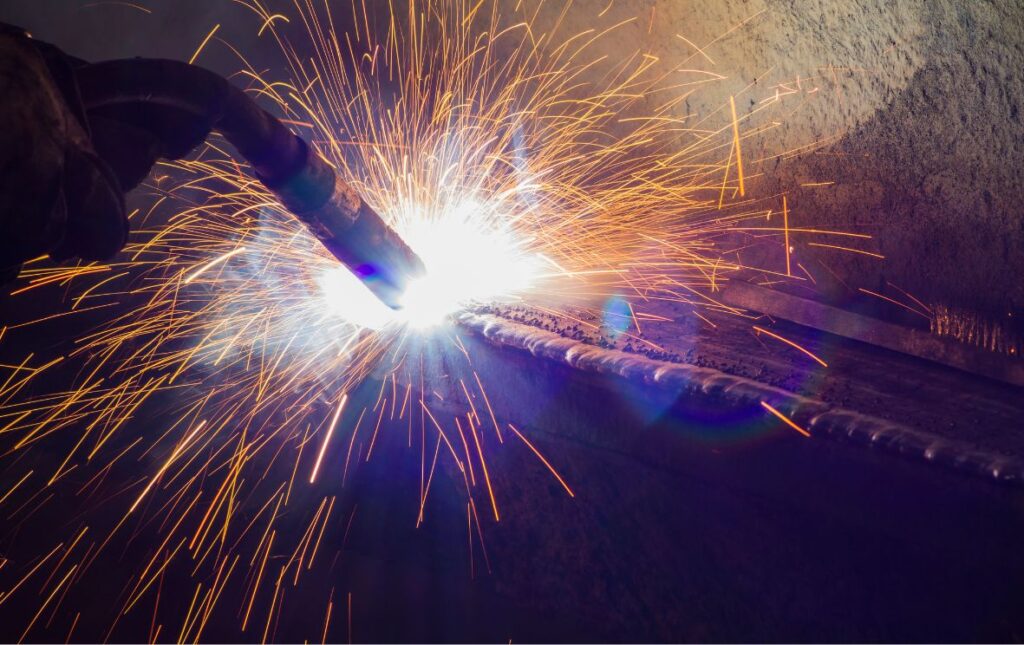
In this blog we take a look at the popular and versatile process of MIG welding.
MIG Welding MIG (Metal Inert Gas) welding, also known as GMAW (Gas Metal Arc Welding), is a semi-automatic process that utilises a continuously fed wire electrode, a shielding gas, and an electric arc to join metals. It’s the preferred choice for many welders due to its speed, ease of use, and ability to produce clean, strong welds.
Let’s take a look at how MIG welding compares to its counterparts: TIG and Stick welding.
MIG vs. TIG (Tungsten Inert Gas) Welding:
- Automation & Speed: MIG welding uses a continuously fed wire, making it significantly faster and more automated than TIG.
- Skill Level: MIG welding generally has a shallower learning curve. TIG welding demands a higher level of skill and can be more challenging to master.
- Material Thickness: MIG excels at welding a wide range of material thicknesses, from thin sheet metal to thicker plates.
- Appearance: While MIG can produce good-looking welds, TIG is renowned for its aesthetically superior, clean, and precise welds.
- Shielding Gas: Both use an inert gas. MIG commonly uses Argon/CO2 mixtures or 100% CO2, while TIG primarily uses 100% Argon.
MIG vs. Stick (Shielded Metal Arc) Welding:
- Electrode: MIG uses a continuous wire electrode fed from a spool. Stick welding uses a consumable stick electrode coated in flux.
- Slag: Stick welding produces a slag layer that needs to be chipped away after each weld, while MIG welding produces very little to no slag.
- Ease of Use: MIG is generally easier to learn and use, especially for beginners, as it’s a more forgiving process. Stick welding requires more practice to maintain a consistent arc and handle electrode changes.
- Duty Cycle & Productivity: MIG welding offers a higher duty cycle and is significantly more productive due to its continuous wire feed, leading to less downtime for electrode changes.
- Portability & Outdoor Use: Stick welding is often more portable and better suited for outdoor use and less-than-ideal conditions, as its flux coating helps protect the weld from atmospheric contamination. MIG welding requires a shielding gas, which can be affected by wind.
Advantages of MIG Welding
- High Productivity & Speed: The continuous wire feed minimises downtime for electrode changes, leading to faster welding speeds and increased output.
- Ease of Use: Its semi-automatic nature and relatively forgiving arc make it easier for beginners to learn and achieve quality welds.
- Versatility: MIG can weld a wide range of ferrous and non-ferrous metals, including carbon steel, stainless steel, and aluminium, across various thicknesses.
- Clean Welds: Minimal spatter and no slag mean less post-weld cleanup, saving time and effort.
- Good Weld Appearance: With proper technique, MIG can produce smooth, consistent, and aesthetically pleasing welds.
Types of MIG Wire:
- Solid Wire: Most common for steel and stainless steel, requiring an external shielding gas.
- Flux-Cored Wire (FCAW): Contains a fluxing agent within the wire, which produces its own shielding gas. This type is often used for outdoor welding or on dirty material and doesn’t always require external gas (depending on the type of flux-cored wire).
- Aluminium Wire: Specifically designed for welding aluminium, requiring 100% Argon shielding gas.
Choosing the correct MIG wire for your application is crucial for achieving optimal results. Factors to consider include the type of metal being welded, its thickness, and the desired mechanical properties of the weld. Our expert team at Thuthuka Welding Products can guide you in selecting the perfect MIG wire for your specific needs, ensuring strong, reliable, and efficient welds every time.